
Making ink from acorn caps

I have decided to experiment with making my own ink, with a view to create an ink that is ‘fugitive’, meaning quick to fade. You could think of it as a kind of 'disappearing' ink, although the intention is for the change to occur gradually over months or years, not instantly. This is, of course, the opposite of what most people seek in an ink, where maximum lightfastness is usually the goal.
For me, though, the fading nature of the ink is synonymous with the concepts of ephemerality and transience that I’m exploring as part of my MA work in relation to the fading remains of the medieval fish trap at Aberarth.
Through my research, both online and in books, I’ve discovered that natural pigment extracted from boiled plants tends to be the most fugitive, so that’s where I plan to begin.
I am following a recipe for silvery acorn cap ink from the book Make Ink by Jason Logan, but I also came across some interesting natural ink suggestions in Japanese Woodcut by Carol White Justin, which recommended mixing the ink with nori paste to achieve the right consistency for printmaking. This was particularly interesting as I had envisioned using the ink for Japanese woodblock printing (Mokuhanga).
The Process
The recipe I’m following calls for acorn caps to be boiled in water with rusty nails, and, after an hour, the liquid had already turned a deep black. Another 30 minutes and I was left with a rich, black brew.
It certainly looked like ink, and I was eager to test it. Once it had cooled, I brushed a little onto the back of an envelope using a paintbrush, and this was the result:
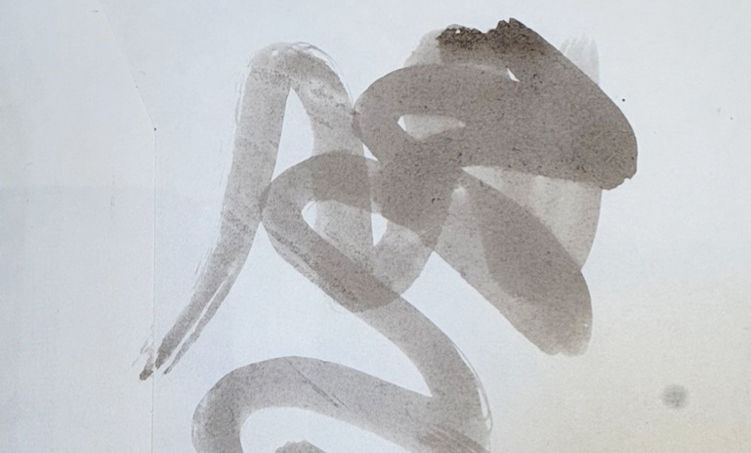
I was pleased with the shade, which came out silvery and almost pewter-like, but I was interested in trying to deepen the colour, so I strained some of the ink into a small clean jar and put the rest back in the pan to boil, adding extra acorn caps and rusty pieces as the book suggested.
Whilst waiting for the mixture to boil I remembered I had a pad of Hahnemuhle Sumi-e paper for Japanese ink painting and the difference was quite amazing, here are the results of both inks on the Sumi-e paper , as you can see, the paper absorbed the ink and deepened the colour remarkably.
The next step will be to test how fugitive this ink truly is by exposing samples to sunlight and comparing the results over time. I’m also keen to explore more of the recipes from the book as this experiment continues.


Comments